

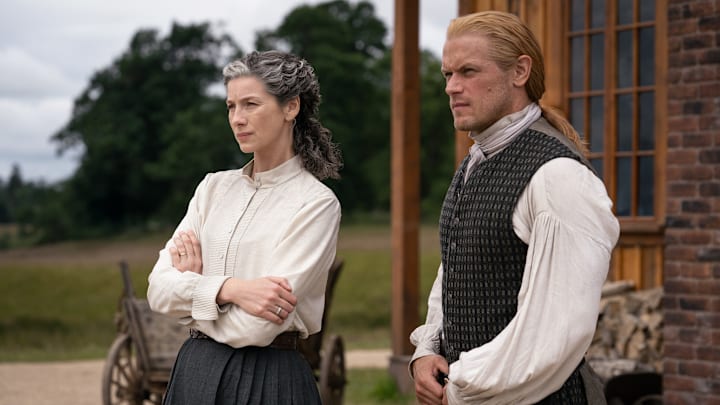
We have officially reached the second half of Outlander season 8! Episode 6, “Blessed Are the Merciful,” doesn’t really provide a resolution to our characters’ problems. Instead, this episode offers an overview of the consequences of some of their choices.
The episode picks up in the immediate aftermath of the attack on Fraser’s Ridge. Thanks to Claire, Cunningham survives, but he will never walk again. Eventually, Jamie brings him justice by showing him mercy. But it’s not an act of weakness on Jamie’s part; it’s something more deliberate. Cunningham, once a figure of authority, is now a living warning. Keeping him alive ensures that the cost of betrayal is enduring.
The fate of the conspirators hangs over Fraser’s Ridge like a gathering storm. After all, the real enemy is not Cunningham, but Major Patrick Ferguson, who still wants Jamie dead. And that devil is still on the loose.
The central moral tension of this episode can be boiled down to this universal truth: mercy is not always kind. Jamie’s refusal to kill Cunningham can be interpreted as both an act of restraint and an act of cruelty. While he avoids becoming an executioner, he still condemns Cunningham to a prolonged existence he no longer wants.
Claire is caught in the middle of that choice, as she so often is. Her instinct is always to preserve life, but she has prolonged a life that Cunningham no longer wants. Healing, in this case, isn’t purely an act of compassion. It’s also part of a larger chain of cause and effect that Claire and Jamie cannot fully control.
Jamie’s handling of the traitors reinforces this. His initial instinct is uncompromising: betrayal must be met with decisive punishment. Following Claire’s advice, he allows space for mercy and strikes a deal with the wives of the conspirators: the land grants will be upheld by the women, not the men. Jamie does not abandon his authority, but he adapts it to preserve a sense of humanity in an increasingly unstable world.

Two young Murrays are better than one
Young Ian and Rachel travel north in search of his former Mohawk family. They go to Joseph Brant, a Mohawk landowner, who chastises Ian for abandoning his people and joining forces with the Continental Army. Ian has to fight against the political backdrop of this season to reconnect with his past. But it proves successful, thanks to Rachel’s peaceful intercession.
Ian’s first wife, Emily/Wahionhaweh, is alive and well, with her children. A dream she had brings her to the difficult decision to entrust their son, Ian James/Swiftest of Lizards, to Ian and Rachel. Along with him, Emily gives Ian a puppy she claims to be the “grandson” of Rollo, Ian’s faithful wolf. As if the scene couldn’t get more heartbreaking – and heartwarming – Emily names Ian and Rachel’s son, and Oggy becomes Hunter.

I think I’ve seen this film before…
Meanwhile, William is reunited with his cousin Benjamin, who isn’t dead but has instead joined the Continental Army, faked his death, and changed his name in order to preserve his family’s reputation. Moreover, it was all Amaranthus’ idea. When her name is brought up, William can’t contain his emotions, and Ben quickly realizes the depth of his cousin’s feelings for his wife.
If this scene sounds familiar, it’s because it is. It echoes the infamous line “I’ve had carnal knowledge of your wife,” doesn’t it? Jamie and John Grey went through the same thing in season 7, and their friendship never recovered.

Roger chooses to follow “God’s plan”
The external conflict – the Siege of Savannah – brings to an end Roger’s internal conflict. His experience in the fighting seems to finally clarify his sense of purpose. He tells Brianna he wishes to be ordained and officially become a minister.
His decision stems from a “vision” he had while in the battlefield. The blast that knocked him unconscious triggered a memory from his childhood: him being thrown and caught by his father on the day Roger's mother died.
Roger seems to believe something that viewers and characters have been questioning since season 1. Having saved his father in the 1700s, he used to believe that he had also changed history. But since his father ended up saving Roger in the 1900s, it’s now clear how it was always supposed to happen. He puts it in a more “divine” perspective, quoting God’s plan, but it doesn’t change the fact that this revelation is fundamental to the Outlander series.
By the end of “Blessed Are the Merciful,” no storyline is neatly resolved. It seems we’ll have to tune in next week to see the consequences of what this episode has set in motion.
 Add us as a preferred source on Google