

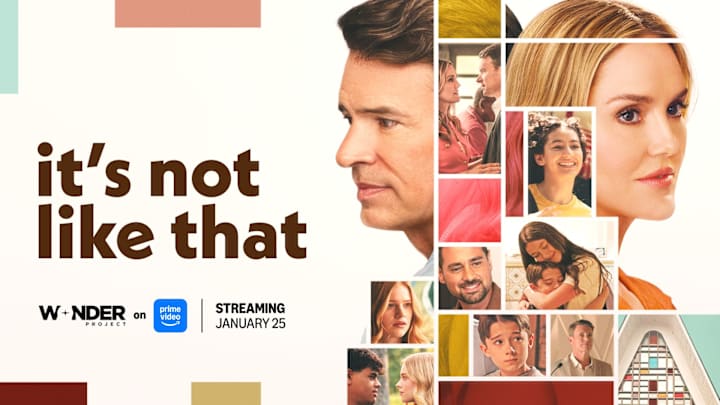
We’re all in need of fresh and unique shows, and that’s something It’s Not Like That offers. On the one hand, it focuses on grief after death, with Malcolm, a recently widowed pastor, navigating the world as a single dad of two teens.
On the other hand, we have Lori, who is freshly divorced from David and now navigating the world of dating apps and life as a co-parent. The two families used to do everything together, and now things are changing with their lifestyles taking a turn.
Showrunners and creators Ian Deitchman and Kristin Robinson discuss the series, with the topics of grief and also that hint of romance that could blossom. They also share the inspiration for the show, which is a little more realistic than you would think.

Claire & Jamie: Let’s start with the inspiration for the series. Where did that come from?
Ian Deitchman: It was connected to us personally, but also to some close friends and family that Kristen and I, and my wife, have. We had a friend from college who passed away from cancer and left a family behind, and then my wife and I had friends whom we made through our kids, which is always a unique experience, and they very suddenly got divorced.
In fact, the scene where Lori and Malcolm are on the couch together and going through the iPad of dating guys and Lori says to Malcolm, “Just pick one,” actually happened to me. My friend was going through her iPad, and I just started mocking the guys.
Kristin and I started talking about it, and we wanted to do a show with these two families going through this, and if there was a romantic through-line that could drive the series, it would be something interesting. It had every element that we wanted to write.
And just like that, we have it.
Kristin Robinson: Also, our background in television with Jason Katims and Parenthood made it our wheelhouse with family and relationship-oriented content.

It’s so relatable for us. Even if you’ve not been widowed or through a divorce, there is something relatable about the series. I do want to touch on the topic of divorce and grief in divorce, because it’s not highlighted that much. Can you touch on including that in the story?
KR: That’s from personal experience, for sure. As Ian said, knowing someone who was a young mother who had been left by her husband. We draw on personal experience, and I also think it was a unique opportunity to tell a grief story from multiple perspectives.
Each of Malcolm’s kids are experiencing it in very different ways. They’re very different kids, and they’re processing it in different ways. As a family, they’re processing it, and it was just an opportunity to tell the kind of story that hasn’t been seen before and also find some of the lightness around the space.
ID: Kristin and I somehow like stories about death and grief. We always have. We wrote the movie Life As We Know It, and I remember we pitched it to our gents, and our agents were like, “And, it’s a comedy?” [Finding the comedy] is easy for us. It’s always been fun.
The fun is writing something that is hopefully honest and emotional and then finding the comedy that lives within those scenes. It’s certainly what we learned from working on Parenthood. The original version of this pilot script was the first TV pilot we wrote, and we were lucky enough that it got into Jason’s hands, and he hired us on Parenthood off it.
We learned so much working on 22 episodes of that first season about living in the small moments of the scenes, so they resonate and feel bigger, because we have all been there. We’ve all loved somebody and had friends that we’ve lost. Grief is universal.

Let’s discuss the romance of it, because they’re not looking for love at the start. They’re not ready for it at the beginning. Can you talk about the development of that?
ID: That was one of the things that was so exciting about the concept. These two people are finding intimacy when we drop in. It’s been a few months, probably nine or 10 months, since his wife passed away and her subsequent divorce, and the idea is their friendship has evolved, because they’ve been with each other through the summer in a kind of weird co-parenting way.
So, that kiss is something that they’ve been building toward, but neither has wanted to acknowledge these feelings. They’ve just started to happen, and then it just very naturally happens, and it’s like, “What have we done? We just screwed everything up, didn’t we?”
That’s the question that is driving the whole series, really, but certainly the first season. It was important to us to not play that conflict lightly, but to have our main characters, Malcolm and Lori, both be aware that they’ve crossed a line, and that there are all kinds of implications and complications by doing that. We want to play that out over time.
And it rolls into the idea of second chances. Everyone has a second chance in this show — not just your two leads. Why was it important to show that for everyone?
KR: It’s about growth and survival. They all need to go on and have new lives after this, and that looks different for each of them. Hopefully, there’s empowerment and leaning on each other, but there’s a motion that’s relatable for audiences watching at home, that they can feel the hope of that journey.

Do you have plans for season 2?
ID: We are working on that. You’ll see as the season progresses that we’re not going to wrap everything up necessarily. Fingers crossed we’ll have more seasons.
KR: There are great stories for all the members of both our families, so please watch.
So, it’s not designed as a limited series.
ID: Oh no!
KR: It’s limitless.
Check out the full interview with the It’s Not Like That showrunners via video:
This interview has been edited for clarity and length.
It’s Not Like That premieres on Sunday, Jan. 25 on Wonder Project on Prime Video.
 Add us as a preferred source on Google